
(This book review was published with Places Journal as a part of their Bookshelf series. I would like to thank the editors of Places for giving me permission to repost it on my personal website.)
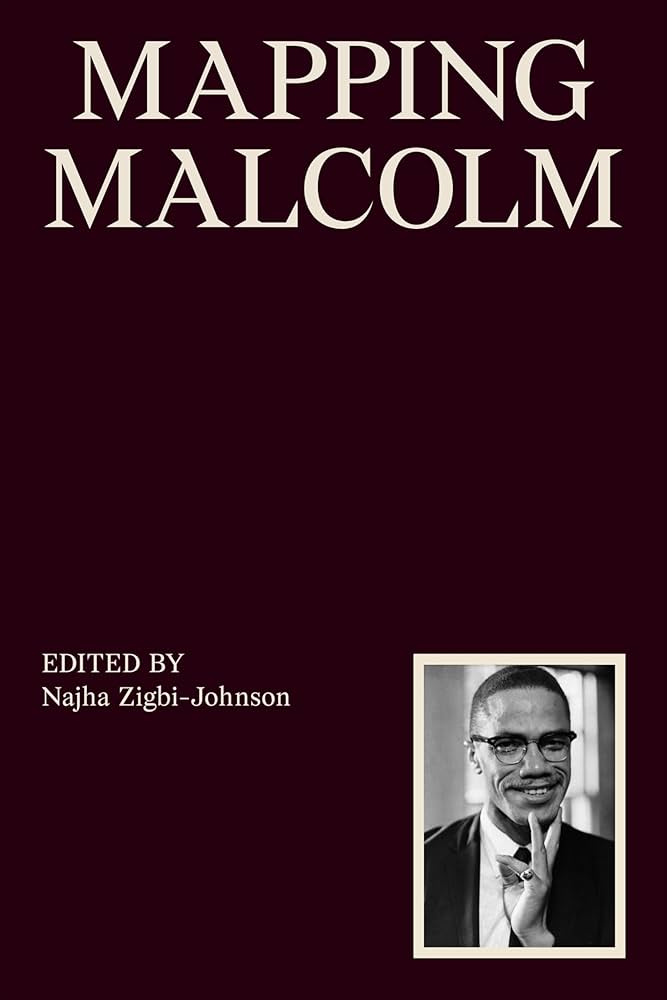
Najha Zigbi-Johnson’s edited volume, Mapping Malcolm, re-examines the scholarship and legacy of Malcolm X using the analytical lenses of Black Geography and placemaking theory. The book is also a very personal retelling of Malcolm’s life. The radical Black tradition that Malcolm represents is anchored in 1960s Harlem, and simultaneously situated within an internationally networked context. Reading this text, one is always in Harlem, and always connected to the world.
The contributors use new interviews, experimental photography, personal reportage, and transdisciplinary spatial interpretations of sites significant in Malcolm’s biography, both domestic and international. They collectively build upon the research and methodologies of countercultural biographers such as Manning Marable; the close reading strategies of urban theorists such as Edward Soja and bell hooks; and the analytical frameworks of contemporary theorists of the Black Geographic, from Sylvia Wynter and Sadiya Hartmann to Camilla Hawthorne.
In terms of disciplinary relevance, Zigbi-Johnson’s assembled contributions comprise a form of instruction: How can architectural historians create spatial histories of architecture and place, rather than architectural histories of space? Mapping Malcolm upends the reductive political function of “mapping” as a form of capitalist and colonial cartography, and instead uses the term to refer to a synthetic interpretation of the international extents of Black diasporic thought — on freedom, religious enlightenment, political autonomy, and artistic expression.
Perhaps the best example of this subversion is Ladi’Sasha Jones’s essay, which pairs maps produced by the Organization of Afro-American Unity, which Malcom launched in 1964, with maps of the African slave trade, so as to trace the global dispersion of Black prophetic thought. Zigbi-Johnson’s opening essay is similarly exemplary, in that it treats the Audubon Ballroom, the site of Malcolm X’s assassination, not as an architectural project or historic site, but as an evocative, meditative space where political commitments to radical social change materialize. Through these essays and others, Mapping Malcolm draws a map for transforming the tropes of architectural historiography.


 Race & Architecture