
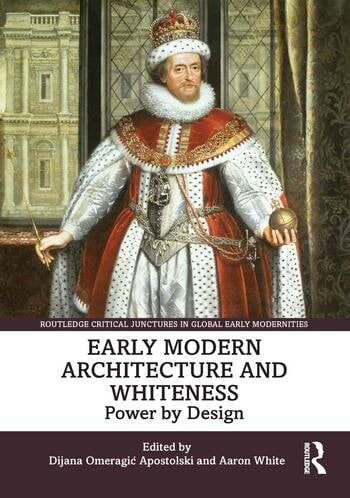
(I want to thank Routledge for permitting me to republish the Foreword to Early Modern Architecture and Whiteness: Power by Design (Routledge, 2025) on my academic blog. You can find both a hardcopy and ebook’s of this text both here and here. Many thanks to teh book’s editors, Dijana Omeragić Apostolski and Aaron White, for inviting me to contribute.)
TABLE OF CONTENTS
Foreword – Charles L. Davis II
Introduction – Dijana O. Apostolski and Aaron White
Part 1 Constructing the Racialized Body
1. St. Francis/San Francesco: White, Incorrupt, Divine – Rebecca M. Howard
2. The Man of Swarthy Complexion: From Bernini’s Biographies to the (De)construction of Color – Fiona Sit
3. “The Dead Body of a Moor”: Michelangelo, Anatomy, and Racecraft in Sixteenth-Century Rome – Dijana O. Apostolski
4. “To Blanch an Aethiop“: Inigo Jones, Queen Anna, and the Staging of Whiteness – Aaron White
Part 2 Constructing the Racialized Body-Politic
5. Whitewashing Legibility: Property Surveys and the Logic of Colonial Whiteness in Eighteenth-Century Senegal – Dwight Carey
6. Muiscas and Moriscos from within the Spanish Grid: Privileged Mixed-Blood Settlers in the Foundational Records of Villa de Leyva (Colombia, 1572–1582) and Campillo de Arenas (Spain, 1508–1539) – Manuel Sánchez García
7. The Appropriation of Mexican Indigenous Material Culture: Architecture, Urban Design, and Antiquarianism in Eighteenth-Century Mexico, Spain, and Italy – Juan Luis Burke
8. The Whiteness of Antiquity and Salvation: Tullio Lombardo, Gianmaria Falconetto, and the Saint Anthony Chapel in Padua – Maria Teresa Sambin de Norcen
Afterword – Itohan Osayimwese
Foreword
It is with tremendous gratitude that I sit down to write the foreword to Early Modern Architecture and Whiteness: Power by Design as it provides me an opportunity to reflect upon the critical gaps that currently exist in the academic literature on race and modern architecture. As Dijana Apostolski and Aaron White have so deftly outlined in their introduction, this subject is complicated by the issues that continue to plague our definition and interpretation of modernity itself. What gives the label modern its contemporary meaning, and when did this definition start to influence architecture culture? What social, political, and economic conditions gave rise to our now modern cities and cultures, and were these conditions ubiquitous or divergent around the world? How accurate is it to label a time period early modern or premodern? Is such an approach merely projective of a teleology from our position in the present, or an accurate description of developmental principles in the past? Architectural historians have had to contend with the mythical nature of modern categories almost from the beginning of their training as scholars and professors as they are often appointed to teach within professional schools of architecture. This institutional context, even when it is not explicitly mentioned in our academic publications, quietly influences the avenues through which our audiences discover new scholarship and what critical ideas one must acquire to move beyond inherited pedagogical frameworks. Implicit in this historical debate is a questioning of the assumed break with the past that is often represented by the structure and content of historical surveys of modern architecture. There are still, to this day, many history survey courses on modern architecture that use the early modern period (sometimes defined as starting in 1450 and other times at 1750) as a moment of rupture with the past. This schismatic perspective fuels the presentism of contemporary architecture culture with what Mark Jarzombek has termed the “neo-avant-gardist ideology” of professional education.[1] Within such a context, professional students are conditioned to valorize the modern as a deep and pervasive structure that shapes everything of value in the present while students in the broader humanities have internalized a more cautious attitude toward the ideological function of this disciplinary label.
If the tacit meanings and associations of the label of modern in architectural discourses—as a teleology for interpreting the evolution of history through advances in technology and industrialization—are already problematic, then this situation gets even more complex if one decides to overlay the critical function of race in the shaping of the discipline. As Stuart Hall indicated in his description of race as a “floating signifier,” racial categories have operated as convenient alibis for many forms of power relations in the past.[2] Its meaning was largely contextually driven by the pervading factors of social life and governmentality in each historical and geographical context. The brief scientific rationalization of race in western Europe should suggest to us that its use as a pseudo-empirical label for categorizing difference is yet another phase of its operative function in regulating social and political bodies—not a complete or unprecedented break with the past. Yet the sheer complexity of making such a judgment for its function around the world should give us pause in arguing for any general principles of difference that may have emerged for all modern societies. We cannot know for sure, and so we continue our piecemeal research. As we move along, we challenge previous conceptions of the past to guide the way: How is one to understand race as a critical lens for interpreting human differences in periods before and after the institutionalization of the modern sciences? Are there continuities in the social, political, and economic implications of race thinking between the so-called premodern and modern epochs that have been elided by our use of the label early modern? And in what ways has the desire for the modern to represent a break with the past masked the continuous influence of racial categories in western societies? This volume is an important step in answering many of these questions. It follows up on research started in several thematic roundtables published in the Journal of the Society of Architectural Historians, but with a more pointed conceptual framework for dealing with whiteness as a theme and in a textual format that will be much more accessible to the general researcher in the humanities. I hope it is just the beginning of many more to come.
As we think on beginnings, I would like to contemplate my own scholarly beginnings as a brief aside for what is required to limn the critical function of race in architectural debates. When I first began to research the influence of scientific racism on modern architectural discourses, I was determined to find clear and irrefutable textual evidence of racial bias in the architectural treatises of the past. My strategy was relatively simple—to problematize the canon of modern architectural theory in a way that made it impossible to return to without taking account for its racial biases. I hoped to find specific evidence for the conceptual negation of Blackness that I felt was tacit in the cultural pedigree and civilizational logic of modern architectural history and theory. Coming directly to a doctoral program from a professional school of architecture, I was not entirely prepared to understand how one can mine the nuances and complexities associated with official archives. Initially, I thought the answers would consist of explicit racial argumentations for the production of architectural form. Of course, there are such passages in the writings of modern architectural theorists. As most doctoral students in architecture schools have learned, these can be found in the writings of figures such as Eugene Emmanuel Viollet-le-Duc in France and Gottfried Semper in Germany. Their texts are still foundational to our field’s interpretation of modern architecture. Viollet-le-Duc’s Histoire de l’Habitation Humaine (1875) and Semper’s Der Stil (1860-64) were the two most obvious offenders because they were so plainly anthropological in character, although one can also find a few evocative passages in John Ruskin’s nationalist observations on the country house in The Poetry of Architecture (1837-38). Although there was enough ‘evidence’ in these discreet passages to cobble together evidence of racial bias, this was not enough to indicate a pattern of thinking beyond these individual figures. That required a rigorous study of the biological metaphors in general, which connected race and style within the shared paradigm of architectural organicism. And even this was complicated by the metaphorical approach that many designers took when engaged in actual design as form-finding practices. I needed to access enough background material on the broader social contexts of French, German, British, and American culture to develop an intuitive sensibility for the tacit assumptions that implicitly regulated the racial ideologies of modern criticism. This is ultimately how I discovered the common work that was performed by the concept of ‘character’ in the paradigm of architectural organicism—character judgements provided the discursive concepts that enabled designers to construct an explicitly racialized or nationalized architectural form.
While developing a principled methodology for critiquing the racial biases of the architectural canon was at one level a success, I felt that the most important goal of my research had been completely obviated by its findings. In short, my faith that the racial biases of modern architecture theory were grounded in a pejorative attitude toward Blackness was challenged by what I found in architectural treatises. Of course, I did find such passages. However, the presiding narrative character, if you will, of the architectural treatises I read revealed something slightly different than what I expected. These works were characterized by what I will call a theoretical inversion of Blackness. At one level, this was done by universalizing the conditions of modernity that were specific to its emergence in western Europe. In addition, there was a consistent pattern of acknowledging the design cultures of nonwhite peoples in the antique past while eliding their necessity in the present as a mere footnote in architectural history. In the vast majority of what I read of Viollet-le-Duc, Semper, and Ruskin’s writings, the core arguments of each were not constituted by an explicit negation of the artistic status of primitive or vernacular art. While these viewpoints were present, and indeed constituted the most racist elements of their writings, these findings did not seem to require any external proof. They were tacitly understood to be true, even by those writing across national lines. To use an example I regularly cite in my history survey, Viollet-le-Duc used the following statement to outline the aims of his inaugural lecture at the Ecole des Beaux Arts:
Let us first establish certain overriding facts. The various human races are not equal, and to take the two extremes it is clear that the white races, which have occupied Europe for some three thousand years, are infinitely superior to the black races that have inhabited a large part of Africa since time immemorial. The former have had an orderly history, a series of more or less advancing civilizations, with moments of astonishing splendour; the latter are still where they were twenty centuries ago […] without putting them on the path to progress.[3]
Instead of carefully demonstrating the negation of Blackness in European Enlightenment culture, I found an eliding abnegation of Blackness as each author was committed to documenting the shifting place of whiteness in the West. Whiteness was the real central theme of Euroamerican modern architecture theory. As European nationalism prompted a dynamic competition between the foundational claims of newly modernizing nation states, architectural critics produced mythological ethnographies to trace the lineage of their newly invented contemporary styles back to an imagined origin point. Looking back on this moment now, I realize that my dissertation was a personal attempt to find myself in the writings of modern architectural theorists, even if this reflection only appeared as a pejorative reference. But even that was too much to ask for in the narrative logic of the canonical texts I read. Instead, I discovered that I was not the only one personalizing the historical definition of modern architecture; white authors did the same, but from their cloistered perspective as a European national. Architectural history became a collective narration of the European subject’s perspective of the world, sometimes explicitly stated as such but more often an implicit structuring element of the overriding narrative.
Upon internalizing these revelations, I realized that my path forward had to consist of two complimentary scholarly projects: first, an opening critique of the white racial epistemologies that structured Enlightenment discourses on modern architecture; and second, a principled elaboration of the unique forms of modernity that were inaugurated by the Black subjectivities that emerged as formerly enslaved peoples adapted themselves to new patterns of modernization in the United States. This latter project, at least as I am defining it now, strongly suggests to me that Black architectural modernity is initially spatial in its conception but becomes formal as Black agency increases around the world. In contemporary terms, this bifurcation of my research is now being defined as the distinction between the agency represented by Indigenous movements of decolonization and the self-awareness of critical discourses of decoloniality that settler subjects must use to rethink their relationship to colonial systems. With these lessons, I began to see modern architectural theory in the ways Ralph Ellison taught us to look at the literary canon, through the hard, distorted mirrors of the white gaze that have defined the canonical standards we wrestle with in the present.
I took this aside to demonstrate what scholars of race have learned in one way or another; that the study of race requires a contextual approach that grounds both the historian and his or her subject. The historian must also find a way of expanding official archives to interpret what the tacit values that are embodied in the textual and visual evidence typically used to explore a topic. And even then we must keep in mind that the colonial biases institutionalized in the very notion of the archive can misdirect us into accepting one set of ideals as the official, authoritative, or universal record of the past. As Ariella Azoulay notes in her text Potential History: Unlearning Imperialism, the archives upon which the expertise of the connoisseur lies—from state archives and university libraries to the museums and treatises of the past—are complicit in the extractive practices of colonization.[4] Decolonial scholars such as Arturo Escobar and Walter Mignolo even suggest that such extractions were constitutive of European modernity as they provided its subjects with the means of knowing whiteness as a social and political structuring force of colonial modernities. History as a discipline has even been implicated as an extractive disciplinary regime that must be reformed if it is to produce a history of the nonwhite subject that operates as more than a mere corollary to the historic march toward white modern progress. Saidiya Hartman’s Wayward Lives, Beautiful Experiments is a testimony to the histories we can reveal when one is ready to replace the pathological depictions of Blackness found in colonial archives with the skillful recovery of alternative modalities of Black modern life.[5]
It is for these reasons that the present volume is an important contribution to the literature on race and modern architecture. For it undertakes the important work of decolonization within the discipline, both in its insistence upon mining the long histories of racial categories in architectural discourses and in its ability to interpret the continuous historical formations of power that employed racialized architectures to visually and spatially ordered the western world. We cannot reform the discipline of architecture if we cannot articulate its concomitant function in reproducing hegemonic power relations. I would characterize Early Modern Architecture and Whiteness: Power by Design as a critical project that models new strategies for demolishing the false binary that separates so-called modern and premodern studies. If power employs new tools to maintain its grasp, even as it adjusts to new technologies and systemic forms of governmentality, then articulating the ways that ‘race’ operates as an overlay onto these systems connects us to the deep past. This sort of project is sorely needed to overcome what Mark Jarzombek has described as the neo-avant-gardist ideologies operating in most elite schools of architecture. What better way to move beyond the binary construction of the premodern/modern epochs of the historical survey than to question the very notion of the Early Modern as a stable category in the teleological evolution of western progress. At least one anecdote for the presentism that plagues architectural education is a principled engagement with the racial epistemologies of our discipline.
How does one create alternatives to the periodization of the Early Modern? As this volume demonstrates, it is not by inventing an entirely new totalizing logic, but by introducing careful hermeneutical studies of phenomenon previously hidden under this disciplinary label. While it has been argued that modern conceptions of ‘race’ required the invention of the sciences, and particularly of biology and anthropology as they would emerge in the 18th and 19th centuries, it should not be impossible to demonstrate the ways that racial categories were overlaid onto continuing social, political, and economic systems of difference. Even if biological conceptions of ‘race’ needed to be invented to operate as a shorthand for European colonial power, European power was already premised on a tribalism that separated folk based on provisional categories of difference—sometimes immutable and other times cultural. In this way, a scientific notion of race merely operated as an overlay onto the systems of power and difference that one can find in the schematic historical categories we labor under today, from the pre-modern and the early modern to the modern, late modern and even postmodern of yesteryear. Azoulay demonstrates this tendency with her postcolonial history of photography, treating its invention as a technological update for long-held practices of concretizing essentialist models of cultural differences: photography as ethnographical ‘evidence’ represents a continuity of power relations and not a break with the past.
In the heavily Eurocentric conception of modernity that is still taught in many architectural schools in the United States, this volume’s recovery of the formative role of whiteness in the formation of Jacobean national architectural traditions has been very illuminating. It prepares the grounds for constructing new long histories of the modern world that would otherwise be counterintuitive. For example, the study of the modern theater has often been framed as a chronology of new technological approaches to structurally framing one’s experience of the stage. Speculations in forced perspective, mechanized stage movement, and modernist stage sets have all propped up technological histories of the modern theater for years, and even extended into modernist film studies scholarship on the spatial complexities of Jacque Tati’s Playtime. And yet the continuous meaning and imperial character of the modern gaze within the theater—as in always produced for and anticipating by the elite western subject—can now be challenged for its legitimation of the persistent whiteness of this aesthetic practice. Aaron White’s critique of Inigo Jones’ “Masque of Blackness” (1609) can be connected to Zak Ové’s installation “Black and Blue: Invisible Man and the Masque of Blackness” (2016) as a broad realization of the racial epistemologies of modern practices. A countercultural history of the modern theater might even be constructed by contrasting/relating the multinational practices of blackface to the modern depictions of Black space by minorities that relied upon realist depictions of the modern city to articulate the forms of resistance that were available to the Black subject with the settler colonial context of the United States. Wynn Thomas’ architectural creation of Sal’s Pizzeria in Do the Right Thing presents a fruitful counterpoint to Jacque Tati’s Playtime as a visual construction of Black architectural modernity that W.J.T. Mitchell has persuasively argued replaces the social function of the standing memorial with a multimedia depiction of the real.[6] I look forward to a time when books like this one have enabled us to construct a new survey of architectural history that not only find connections across the premodern/modern binary we have inherited, but that also recover the synthetic forms of Black architectural modernity that are now visible to us operating in a decolonial present. Let’s raise a glass to that future together.
Charles L. Davis II
Austin, Texas
May 2024
[1] This term was excerpted from Mark Jarzombek’s comments during a lecture at the Canadian Center for Architecture on 6 April 2017. See “A Conversation with Kenneth Frampton: Can There Be a Global Architectural History Today?,” https://www.youtube.com/watch?v=QRWp5AqAZjs, accessed on 4 May 2024. Jarzombek’s comments begin at the one hour mark.
[2] Stewart Hall, “Cultural Studies and its Theoretical Legacies,” reprinted in Stuart Hall: Critical Dialogues in Cultural Studies, edited by David Morely and Kuan-Msing Chen (London: Routledge, 1996), 261-274.
[3] Eugene Emmanuel Viollet-le-Duc, “First Lecture at the Ecole des Beaux-Arts,” reprinted in Eugene Emmanuel Viollet-le-Duc, 1814-1879 (London: Academy Editions, 1980), 21.
[4] Ariella Azoulay. Potential History: Unlearning Imperialism (London and New York: Verso, 2019)
[5] Saidiya Hartman. Wayward Lives, Beautiful Experiments: Intimate Histories of Social Upheavals (New York: W. W. Norton & Company, 2019)
[6] W.J.T. Mitchell, “The Violence of Public Art: “Do the Right Thing,” Critical Inquiry, vol. 16, no.4 (Summer, 1990), 880-899

 Race & Architecture